

Regression Part II#
OBJECTIVES
Use
sklearnto build multiple regression modelsUse
statsmodelsto build multiple regression modelsEvaluate models using
mean_squared_errorInterpret categorical coefficients
import matplotlib.pyplot as plt
import numpy as np
import pandas as pd
import seaborn as sns

from sklearn.linear_model import LinearRegression
from sklearn.metrics import mean_squared_error
---------------------------------------------------------------------------
ModuleNotFoundError                       Traceback (most recent call last)
Cell In[1], line 4
      2 import numpy as np
      3 import pandas as pd
----> 4 import seaborn as sns
      6 from sklearn.linear_model import LinearRegression
      7 from sklearn.metrics import mean_squared_error

ModuleNotFoundError: No module named 'seaborn'
Using Many Features#
The big idea with a regression model is its ability to learn parameters of linear equations.
tips = sns.load_dataset('tips')
X = tips['total_bill'].values.reshape(-1, 1)
y = tips['tip'].values.reshape(-1, 1)
intercept = np.ones(shape = X.shape)
design_matrix = np.concatenate((intercept, X), axis = 1)
design_matrix[:5]
array([[ 1.  , 16.99],
       [ 1.  , 10.34],
       [ 1.  , 21.01],
       [ 1.  , 23.68],
       [ 1.  , 24.59]])
np.linalg.inv(design_matrix.T@design_matrix)@design_matrix.T@y
array([[0.92026961],
       [0.10502452]])
Advertising Data#
The goal here is to predict sales. We have spending on three different media types to help make such predictions. Here, we want to be selective about what features are used as inputs to the model.
ads = pd.read_csv('https://raw.githubusercontent.com/jfkoehler/nyu_bootcamp_fa24/main/data/ads.csv', index_col=0)
ads.head()
| TV | radio | newspaper | sales | |
|---|---|---|---|---|
| 1 | 230.1 | 37.8 | 69.2 | 22.1 |
| 2 | 44.5 | 39.3 | 45.1 | 10.4 |
| 3 | 17.2 | 45.9 | 69.3 | 9.3 |
| 4 | 151.5 | 41.3 | 58.5 | 18.5 |
| 5 | 180.8 | 10.8 | 58.4 | 12.9 |
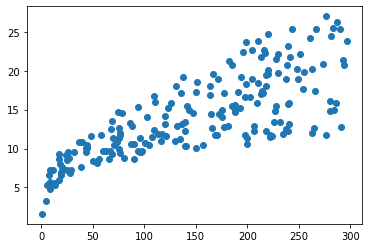
#scatterplot
plt.scatter(ads['TV'], ads['sales']);
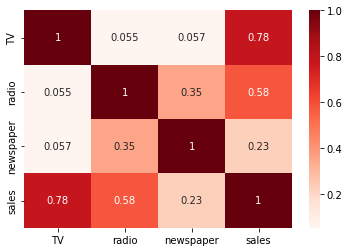
# heatmap
sns.heatmap(ads.corr(), annot = True, cmap = 'Reds');
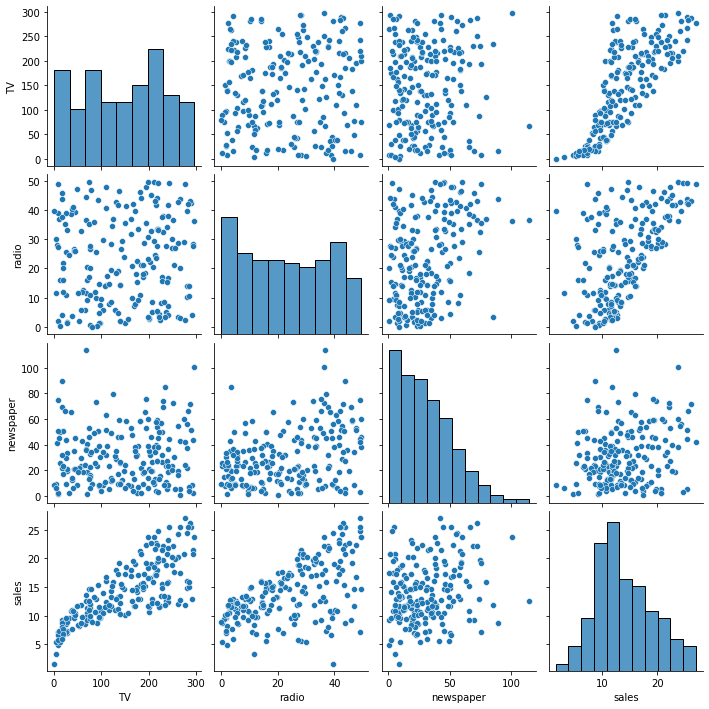
# pairplot
sns.pairplot(ads);
Choose a single column as
Xto predict sales. Justify your choice – remember to makeX2D.
#declare X and y
X = ads[['TV']]
y = ads['sales']
Build a regression model to predict
salesusing yourXabove.
# instantiate and fit the model
model1 = LinearRegression().fit(X, y)
Interpret the slope of the model.
# examine slope, what does it mean?
model1.coef_
array([0.04753664])
Interpret the intercept of the model.
#intercept
model1.intercept_
7.032593549127695
Look over the documentation for the
mean_squared_errorfunction and use it to evaluate themean_squared_errorof the model.
from sklearn.metrics import mean_squared_error
# MSE
mean_squared_error(y, model1.predict(X))
10.512652915656757
Create baseline predictions using the mean of
y.
y.shape
(200,)
np.ones(y.shape).shape
(200,)
y.mean()
14.0225
# ones
baseline = np.ones(y.shape)*y.mean()
# multiply by mean
baseline[:5]
array([14.0225, 14.0225, 14.0225, 14.0225, 14.0225])
mean_squared_error(y, y.mean())
Compute the
mean_squared_errorof your baseline predictions.
# MSE Baseline
mean_squared_error(y, baseline)
27.085743750000002
Did your model perform better than the baseline?
#Yes!
the .score method#
In addition to the mean_squared_error function, you are able to evaluate regression models using the objects .score method. This method evaluates in terms of \(r^2\). One way to understand this metric is as the ratio between the residual sum of squares and the total sum of squares. These are given by:
and
#model score
model1.score(X, y)
0.611875050850071
You can interpret this as the percent of variation in the data explained by the features according to your model.
Adding Features#
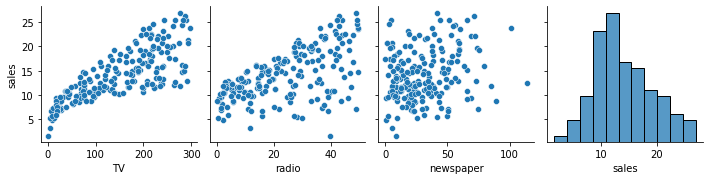
Now, we want to include a second feature as input to the model. Reexamine the plots and correlations above, what is a good second choice?
Choose two columns from the
adsdata, assign these asX.
sns.pairplot(ads, y_vars = 'sales')
<seaborn.axisgrid.PairGrid at 0x7fc8cec9cdf0>
# X2
X2 = ads[['TV', 'radio']]
Build a regression model with two features to predict
sales.
# lr2 model
model2 = LinearRegression().fit(X2, y)
Evaluate the model using
mean_squared_error.
# yhat2
yhat2 = model2.predict(X2)
# MSE
mean_squared_error(y, yhat2)
2.784569900338091
Interpret the coefficients of the model
# make a dataframe here
pd.DataFrame(model2.coef_, index = X2.columns)
| 0 | |
|---|---|
| TV | 0.045755 |
| radio | 0.187994 |
Using statsmodels#
A different library for models is the statsmodels library. This contains more classic statistical modeling approaches including a statistical summary of the fit. The interface is slightly different than that of sklearn.
Fit a regression model using
statsmodels.
import statsmodels.api as sm
# instantiate and fit
model3 = sm.OLS(y, X2).fit()
Examine the summary of the model using
.summary().
# model summary
print(model3.summary())
                                 OLS Regression Results
=======================================================================================
Dep. Variable:                  sales   R-squared (uncentered):                   0.981
Model:                            OLS   Adj. R-squared (uncentered):              0.981
Method:                 Least Squares   F-statistic:                              5206.
Date:                Thu, 24 Oct 2024   Prob (F-statistic):                   6.73e-172
Time:                        16:09:34   Log-Likelihood:                         -426.71
No. Observations:                 200   AIC:                                      857.4
Df Residuals:                     198   BIC:                                      864.0
Df Model:                           2
Covariance Type:            nonrobust
==============================================================================
                 coef    std err          t      P>|t|      [0.025      0.975]
------------------------------------------------------------------------------
TV             0.0548      0.001     42.962      0.000       0.052       0.057
radio          0.2356      0.008     29.909      0.000       0.220       0.251
==============================================================================
Omnibus:                        6.047   Durbin-Watson:                   2.080
Prob(Omnibus):                  0.049   Jarque-Bera (JB):                8.829
Skew:                          -0.112   Prob(JB):                       0.0121
Kurtosis:                       4.005   Cond. No.                         9.37
==============================================================================

Notes:
[1] R² is computed without centering (uncentered) since the model does not contain a constant.
[2] Standard Errors assume that the covariance matrix of the errors is correctly specified.
Including an intercept term.
# add the constant
X2 = sm.add_constant(X2)
X2
| const | TV | radio | |
|---|---|---|---|
| 1 | 1.0 | 230.1 | 37.8 |
| 2 | 1.0 | 44.5 | 39.3 |
| 3 | 1.0 | 17.2 | 45.9 |
| 4 | 1.0 | 151.5 | 41.3 |
| 5 | 1.0 | 180.8 | 10.8 |
| ... | ... | ... | ... |
| 196 | 1.0 | 38.2 | 3.7 |
| 197 | 1.0 | 94.2 | 4.9 |
| 198 | 1.0 | 177.0 | 9.3 |
| 199 | 1.0 | 283.6 | 42.0 |
| 200 | 1.0 | 232.1 | 8.6 |
200 rows × 3 columns
# fit model
model4 = sm.OLS(y, X2).fit()
# summary
print(model4.summary())
                            OLS Regression Results
==============================================================================
Dep. Variable:                  sales   R-squared:                       0.897
Model:                            OLS   Adj. R-squared:                  0.896
Method:                 Least Squares   F-statistic:                     859.6
Date:                Thu, 24 Oct 2024   Prob (F-statistic):           4.83e-98
Time:                        16:13:23   Log-Likelihood:                -386.20
No. Observations:                 200   AIC:                             778.4
Df Residuals:                     197   BIC:                             788.3
Df Model:                           2
Covariance Type:            nonrobust
==============================================================================
                 coef    std err          t      P>|t|      [0.025      0.975]
------------------------------------------------------------------------------
const          2.9211      0.294      9.919      0.000       2.340       3.502
TV             0.0458      0.001     32.909      0.000       0.043       0.048
radio          0.1880      0.008     23.382      0.000       0.172       0.204
==============================================================================
Omnibus:                       60.022   Durbin-Watson:                   2.081
Prob(Omnibus):                  0.000   Jarque-Bera (JB):              148.679
Skew:                          -1.323   Prob(JB):                     5.19e-33
Kurtosis:                       6.292   Cond. No.                         425.
==============================================================================

Notes:
[1] Standard Errors assume that the covariance matrix of the errors is correctly specified.
# LinearRegression()
Example II: Credit Data#
credit = pd.read_csv('https://raw.githubusercontent.com/jfkoehler/nyu_bootcamp_fa24/main/data/Credit.csv', index_col = 0)
credit.head(2)
| Income | Limit | Rating | Cards | Age | Education | Gender | Student | Married | Ethnicity | Balance | |
|---|---|---|---|---|---|---|---|---|---|---|---|
| 1 | 14.891 | 3606 | 283 | 2 | 34 | 11 | Male | No | Yes | Caucasian | 333 |
| 2 | 106.025 | 6645 | 483 | 3 | 82 | 15 | Female | Yes | Yes | Asian | 903 |
Build a regression model using Ethnicity feature to predict balance. Interpret the coefficients.
#unique values?
credit['Ethnicity'].unique()
array(['Caucasian', 'Asian', 'African American'], dtype=object)
# using get_dummies
pd.get_dummies(credit['Ethnicity'], drop_first=True)
| Asian | Caucasian | |
|---|---|---|
| 1 | 0 | 1 |
| 2 | 1 | 0 |
| 3 | 1 | 0 |
| 4 | 1 | 0 |
| 5 | 0 | 1 |
| ... | ... | ... |
| 396 | 0 | 1 |
| 397 | 0 | 0 |
| 398 | 0 | 1 |
| 399 | 0 | 1 |
| 400 | 1 | 0 |
400 rows × 2 columns
Define
Xandy.
X = pd.get_dummies(credit["Ethnicity"], drop_first=True)
X.head()
y = credit['Balance']
Instantiate and fit.
cat_model = LinearRegression().fit(X, y)
Examine the coefficients.
pd.DataFrame(cat_model.coef_, index = X.columns)
| 0 | |
|---|---|
| Asian | -18.686275 |
| Caucasian | -12.502513 |
Interpret the intercept.
cat_model.intercept_
531.0
Mean Squared Error
yhat = cat_model.predict(X)
mean_squared_error(y, yhat, squared=False)
459.13357998933174
Baseline MSE
baseline = np.ones(y.shape)*y.mean()
mean_squared_error(y, baseline, squared=False)
459.18381915633745
cat_model.score(X, y)
0.00021880744304858535
pd.get_dummies(credit, drop_first=True)
| Income | Limit | Rating | Cards | Age | Education | Balance | Gender_Male | Student_Yes | Married_Yes | Ethnicity_Asian | Ethnicity_Caucasian | |
|---|---|---|---|---|---|---|---|---|---|---|---|---|
| 1 | 14.891 | 3606 | 283 | 2 | 34 | 11 | 333 | 1 | 0 | 1 | 0 | 1 |
| 2 | 106.025 | 6645 | 483 | 3 | 82 | 15 | 903 | 0 | 1 | 1 | 1 | 0 |
| 3 | 104.593 | 7075 | 514 | 4 | 71 | 11 | 580 | 1 | 0 | 0 | 1 | 0 |
| 4 | 148.924 | 9504 | 681 | 3 | 36 | 11 | 964 | 0 | 0 | 0 | 1 | 0 |
| 5 | 55.882 | 4897 | 357 | 2 | 68 | 16 | 331 | 1 | 0 | 1 | 0 | 1 |
| ... | ... | ... | ... | ... | ... | ... | ... | ... | ... | ... | ... | ... |
| 396 | 12.096 | 4100 | 307 | 3 | 32 | 13 | 560 | 1 | 0 | 1 | 0 | 1 |
| 397 | 13.364 | 3838 | 296 | 5 | 65 | 17 | 480 | 1 | 0 | 0 | 0 | 0 |
| 398 | 57.872 | 4171 | 321 | 5 | 67 | 12 | 138 | 0 | 0 | 1 | 0 | 1 |
| 399 | 37.728 | 2525 | 192 | 1 | 44 | 13 | 0 | 1 | 0 | 1 | 0 | 1 |
| 400 | 18.701 | 5524 | 415 | 5 | 64 | 7 | 966 | 0 | 0 | 0 | 1 | 0 |
400 rows × 12 columns
Problem#
Only using Ethnicity to predict the balance is perhaps too simplistic of a model. Select other features you believe to be important to predicting the Balance and build a regression model using these inputs. Interpret your coefficients and discuss the overall performance of the model.
credit.head()
| Income | Limit | Rating | Cards | Age | Education | Gender | Student | Married | Ethnicity | Balance | |
|---|---|---|---|---|---|---|---|---|---|---|---|
| 1 | 14.891 | 3606 | 283 | 2 | 34 | 11 | Male | No | Yes | Caucasian | 333 |
| 2 | 106.025 | 6645 | 483 | 3 | 82 | 15 | Female | Yes | Yes | Asian | 903 |
| 3 | 104.593 | 7075 | 514 | 4 | 71 | 11 | Male | No | No | Asian | 580 |
| 4 | 148.924 | 9504 | 681 | 3 | 36 | 11 | Female | No | No | Asian | 964 |
| 5 | 55.882 | 4897 | 357 | 2 | 68 | 16 | Male | No | Yes | Caucasian | 331 |
X = pd.get_dummies(credit.iloc[:, :-1], drop_first=True)
X.head()
| Income | Limit | Rating | Cards | Age | Education | Gender_Male | Student_Yes | Married_Yes | Ethnicity_Asian | Ethnicity_Caucasian | |
|---|---|---|---|---|---|---|---|---|---|---|---|
| 1 | 14.891 | 3606 | 283 | 2 | 34 | 11 | 1 | 0 | 1 | 0 | 1 |
| 2 | 106.025 | 6645 | 483 | 3 | 82 | 15 | 0 | 1 | 1 | 1 | 0 |
| 3 | 104.593 | 7075 | 514 | 4 | 71 | 11 | 1 | 0 | 0 | 1 | 0 |
| 4 | 148.924 | 9504 | 681 | 3 | 36 | 11 | 0 | 0 | 0 | 1 | 0 |
| 5 | 55.882 | 4897 | 357 | 2 | 68 | 16 | 1 | 0 | 1 | 0 | 1 |
all_features = LinearRegression().fit(X, y)
yhat = all_features.predict(X)
mean_squared_error(y, yhat, squared=False)
97.2976129033722
all_features.score(X, y)
0.9551015633651758
pd.DataFrame(all_features.coef_, index = X.columns)
| 0 | |
|---|---|
| Income | -7.803102 |
| Limit | 0.190907 |
| Rating | 1.136527 |
| Cards | 17.724484 |
| Age | -0.613909 |
| Education | -1.098855 |
| Gender_Male | 10.653248 |
| Student_Yes | 425.747360 |
| Married_Yes | -8.533901 |
| Ethnicity_Asian | 16.804179 |
| Ethnicity_Caucasian | 10.107025 |