

import matplotlib.pyplot as plt
import numpy as np
import sympy as sy
import pandas as pd
---------------------------------------------------------------------------
ModuleNotFoundError                       Traceback (most recent call last)
Cell In[1], line 3
      1 import matplotlib.pyplot as plt
      2 import numpy as np
----> 3 import sympy as sy
      4 import pandas as pd

ModuleNotFoundError: No module named 'sympy'
Introduction to Linear Regression#
OBJECTIVES
Derive ordinary least squares models for data
Evaluate regression models using mean squared error
Examine errors and assumptions in least squares models
Use
scikit-learnto fit regression models to data
Calculus Refresher#
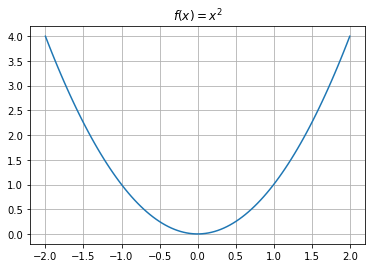
An important idea is that of finding a maximum or minimum of a function. From calculus, we have the tools required. Specifically, a maximum or minimum value of a function \(f\) occurs wherever \(f'(x) = 0\) or is underfined. Consider the function:
def f(x): return x**2
x = np.linspace(-2, 2, 100)
plt.plot(x, f(x))
plt.grid()
plt.title(r'$f(x) = x^2$');
Here, using our power rule for derivatives of polynomials we have:
and are left to solve:
or
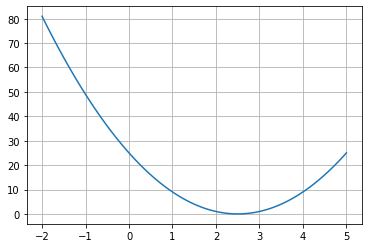
PROBLEM: Determine where the function \(f(x) = (5 - 2x)^2\) has a minimum.
def f(x): return (5 - 2*x)**2
x = np.linspace(-2, 5, 100)
plt.plot(x, f(x))
plt.grid();
Using the chain rule#
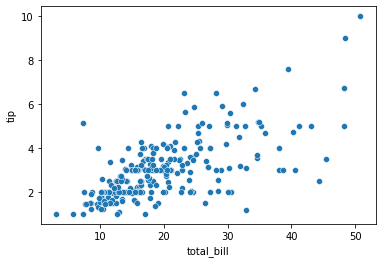
Example 1: Line of best fit
import seaborn as sns
tips = sns.load_dataset('tips')
tips.head()
| total_bill | tip | sex | smoker | day | time | size | |
|---|---|---|---|---|---|---|---|
| 0 | 16.99 | 1.01 | Female | No | Sun | Dinner | 2 |
| 1 | 10.34 | 1.66 | Male | No | Sun | Dinner | 3 |
| 2 | 21.01 | 3.50 | Male | No | Sun | Dinner | 3 |
| 3 | 23.68 | 3.31 | Male | No | Sun | Dinner | 2 |
| 4 | 24.59 | 3.61 | Female | No | Sun | Dinner | 4 |
sns.scatterplot(data = tips, x = 'total_bill', y = 'tip');
def y1(x): return .19*x
def y2(x): return .12*x
x = tips['total_bill']
plt.plot(x, y1(x), label = 'y1')
plt.plot(x, y2(x), label = 'y2')
plt.legend()
sns.scatterplot(data = tips, x = 'total_bill', y = 'tip')
plt.title('How to determine the line of best fit?')
plt.grid();
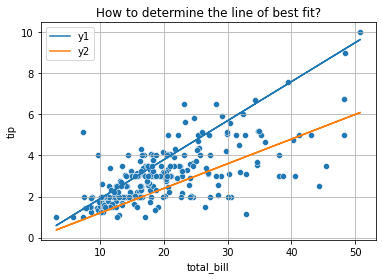
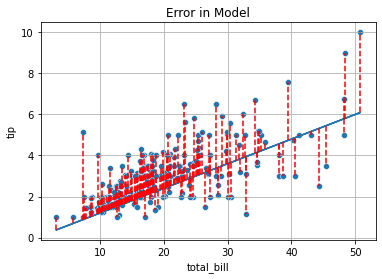
To decide between all possible lines we will examine the error in all these models and select the one that minimizes this error.
plt.plot(x, y2(x))
for i, yhat in enumerate(y2(x)):
    plt.vlines(x = tips['total_bill'].iloc[i], ymin = yhat, ymax = tips['tip'].iloc[i], color = 'red', linestyle = '--')
sns.scatterplot(data = tips, x = 'total_bill', y = 'tip')
plt.title('Error in Model')
plt.grid();
Mean Squared Error#
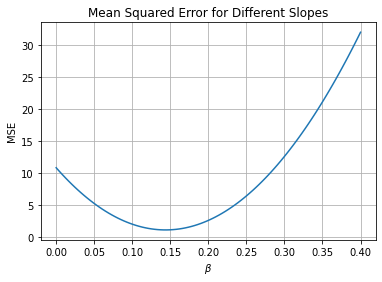
OBJECTIVE: Minimize mean squared error
def mse(beta):
    return np.mean((y - beta*x)**2)
x = tips['total_bill']
y = tips['tip']
mse(.17)
1.502706427336066
for pct in np.linspace(.1, .2, 11):
    print(f'The MSE for slope {pct: .3f} is {mse(pct): .3f}')
The MSE for slope  0.100 is  2.078
The MSE for slope  0.110 is  1.713
The MSE for slope  0.120 is  1.443
The MSE for slope  0.130 is  1.267
The MSE for slope  0.140 is  1.185
The MSE for slope  0.150 is  1.197
The MSE for slope  0.160 is  1.303
The MSE for slope  0.170 is  1.503
The MSE for slope  0.180 is  1.797
The MSE for slope  0.190 is  2.185
The MSE for slope  0.200 is  2.667
betas = np.linspace(0, .4, 100)
plt.plot(betas, [mse(beta) for beta in betas])
plt.xlabel(r'$\beta$')
plt.ylabel('MSE')
plt.title('Mean Squared Error for Different Slopes')
plt.grid();
Using scipy#
To find the minimum of our objective function, the minimize function from scipy.optimize is useful. This relies on a variety of different optimization algorithms to find the minimum of a function.
from scipy.optimize import minimize
minimize(mse, .1 )
  message: Optimization terminated successfully.
  success: True
   status: 0
      fun: 1.1781161154513358
        x: [ 1.437e-01]
      nit: 1
      jac: [ 1.103e-06]
 hess_inv: [[1]]
     nfev: 6
     njev: 3
Solving the Problem Exactly#
From calculus we know that the minimum value for a quadratic will occur where the first derivative equals zero. Thus, to determine the equations for the line of best fit, we minimize the MSE function with respect to \(\beta\).
np.sum(tips['total_bill']*tips['tip'])/np.sum(tips['total_bill']**2)
0.14373189527721666
Adding an intercept#
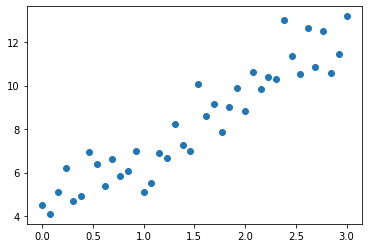
Consider the model:
where \(\epsilon = N(0, 1)\).
np.random.seed(42)
x = np.linspace(0, 3, 40)
y = 3*x + 4 + np.random.normal(size = len(x))
plt.scatter(x, y)
<matplotlib.collections.PathCollection at 0x7f8b45d14250>
Now, the objective function changes to be a function in 3-Dimensions where the slope and intercept terms are input and mean squared error is the output.
def mse(betas):
    return np.mean((y - (betas[0] + betas[1]*x))**2)
mse([4, 3])
0.9329508980248764
minimize(mse, [0, 0])
  message: Optimization terminated successfully.
  success: True
   status: 0
      fun: 0.829630503231984
        x: [ 4.179e+00  2.735e+00]
      nit: 7
      jac: [ 9.686e-08 -2.235e-08]
 hess_inv: [[ 1.921e+00 -9.483e-01]
            [-9.483e-01  6.327e-01]]
     nfev: 24
     njev: 8
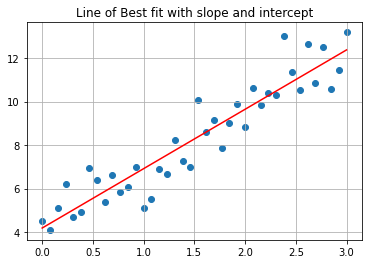
betas = minimize(mse, [0, 0]).x
def lobf(x): return betas[0] + betas[1]*x
plt.scatter(x, y)
plt.plot(x, lobf(x), color = 'red')
plt.grid()
plt.title('Line of Best fit with slope and intercept');
Exercise#
Use the minimize function together with your mse function to complete the class below. After calling the fit method assign the slope of the line of best fit to the .coef_ attribute and the \(y\)-intercept to the .intercept_ attribute.
Test your model on the tips data below.
class LinearReg:
    '''
    This class fits an ordinary lease squares model
    of the form beta_0 + beta_1 * x.
    '''
    def __init__(self):
        self.coef_ = None
        self.intercept_ = None

    def mse(self, betas):
        return np.mean((y - (betas[0] + betas[1]*x))**2)

    def fit(self, x, y):
        #betas that minimize
        betas = minimize(self.mse, [0, 0]).x
        #set coef_
        self.coef_ = betas[1]
        #set intercept_
        self.intercept_ = betas[0]


    def predict(self, x):
        return self.intercept_ + self.coef_*x
x = tips['total_bill']
y = tips['tip']
#instantiate the model
model = LinearReg()
#fit the model on data
model.fit(x, y)
#make predictions on all data
model.predict(x)
0      2.704636
1      2.006223
2      3.126835
3      3.407250
4      3.502822
         ...
239    3.969131
240    3.774836
241    3.301175
242    2.791807
243    2.892630
Name: total_bill, Length: 244, dtype: float64
model.coef_
0.10502447914641161
model.intercept_
0.9202703450693733
A second example#
import statsmodels.api as sm
duncan_prestige = sm.datasets.get_rdataset("Duncan", "carData")
print(duncan_prestige.__doc__)
.. container::

   .. container::

      ====== ===============
      Duncan R Documentation
      ====== ===============

      .. rubric:: Duncan's Occupational Prestige Data
         :name: duncans-occupational-prestige-data

      .. rubric:: Description
         :name: description

      The ``Duncan`` data frame has 45 rows and 4 columns. Data on the
      prestige and other characteristics of 45 U. S. occupations in
      1950.

      .. rubric:: Usage
         :name: usage

      .. code:: R

         Duncan

      .. rubric:: Format
         :name: format

      This data frame contains the following columns:

      type
         Type of occupation. A factor with the following levels:
         ``prof``, professional and managerial; ``wc``, white-collar;
         ``bc``, blue-collar.

      income
         Percentage of occupational incumbents in the 1950 US Census who
         earned $3,500 or more per year (about $36,000 in 2017 US
         dollars).

      education
         Percentage of occupational incumbents in 1950 who were high
         school graduates (which, were we cynical, we would say is
         roughly equivalent to a PhD in 2017)

      prestige
         Percentage of respondents in a social survey who rated the
         occupation as “good” or better in prestige

      .. rubric:: Source
         :name: source

      Duncan, O. D. (1961) A socioeconomic index for all occupations. In
      Reiss, A. J., Jr. (Ed.) *Occupations and Social Status.* Free
      Press [Table VI-1].

      .. rubric:: References
         :name: references

      Fox, J. (2016) *Applied Regression Analysis and Generalized Linear
      Models*, Third Edition. Sage.

      Fox, J. and Weisberg, S. (2019) *An R Companion to Applied
      Regression*, Third Edition, Sage.
sns.lmplot(duncan_prestige.data, x = 'education', y = 'prestige')
plt.title('Education vs. Prestige');
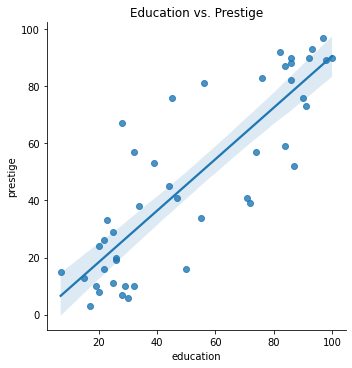
Fit a model with an intercept to the data.
What is the slope of the line and what does this mean in terms of education and income?
What is the intercept of the model and what does this mean in terms of education and income?
x = duncan_prestige.data[['education']]
y = duncan_prestige.data['prestige']
x.shape
(45, 1)
# !pip install -U scikit-learn
from sklearn.linear_model import LinearRegression
model = LinearRegression() #instantiate -- step 1
model.fit(x, y)
LinearRegression()In a Jupyter environment, please rerun this cell to show the HTML representation or trust the notebook.
On GitHub, the HTML representation is unable to render, please try loading this page with nbviewer.org.
LinearRegression()
predictions = model.predict(x)
predictions
array([77.85563665, 68.83567885, 83.26761134, 81.46361978, 77.85563665,
       76.05164509, 84.16960712, 90.48357758, 78.75763243, 77.85563665,
       67.03168729, 88.67958602, 87.77759024, 76.05164509, 82.36561556,
       30.95185608, 40.87380966, 50.79576324, 39.97181388, 74.24765353,
       65.22769573, 49.89376746, 64.32569995, 45.38378856, 21.02990249,
       35.46183498, 25.53988139, 29.14786452, 20.12790671, 22.83389405,
       26.44187717,  6.59797001, 23.73588983, 17.42191937, 13.81393625,
       18.32391515, 23.73588983, 25.53988139, 15.61792781, 20.12790671,
       27.34387295, 22.83389405, 18.32391515, 42.67780122, 29.14786452])
model.coef_, model.intercept_
(array([0.90199578]), 0.2839995438216505)
model.coef_[0]
0.9019957803501166
Examining Errors in the Model#
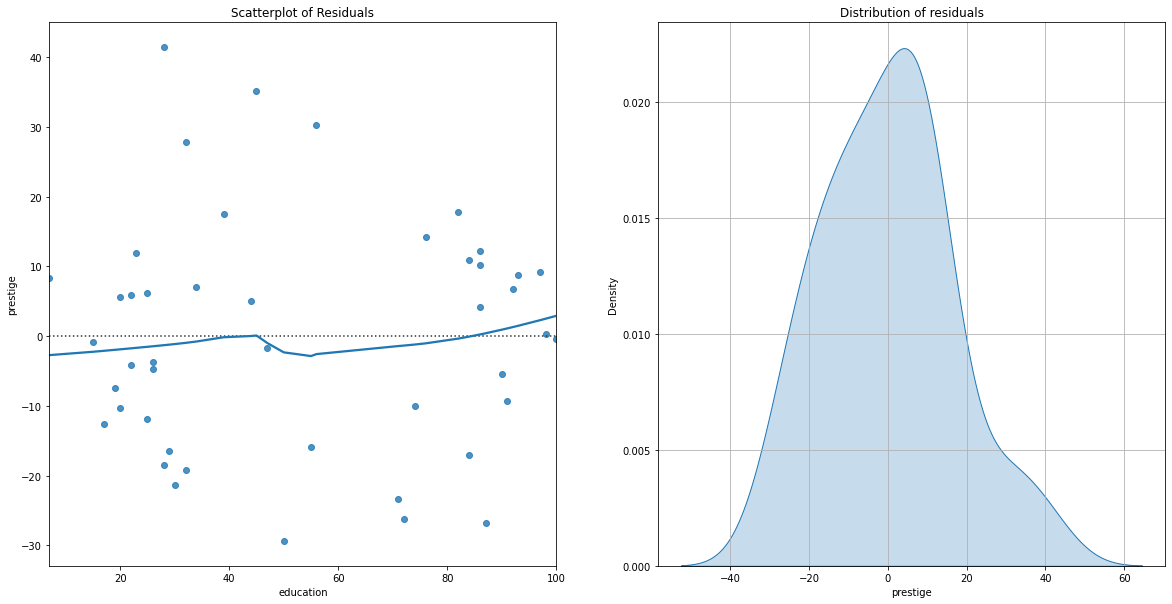
Once we have a model, it is important to examine the properties of the residuals. Specifically, we aim to examine the residuals for patterns in error and the overall distribution of these errors.
fig, ax = plt.subplots(1, 2, figsize = (20, 10))
sns.residplot(x = x, y = y, ax = ax[0], lowess=True)
ax[0].set_title('Scatterplot of Residuals')
sns.kdeplot((y - (model.intercept_ + model.coef_[0]*x.values[:, 0])), ax = ax[1], fill = True);
ax[1].grid()
ax[1].set_title('Distribution of residuals');
Using scikit-learn#
The scikit-learn library has many predictive models and modeling tools. It is a popular library in industry for Machine Learning tasks. docs
# !pip install -U scikit-learn
credit = pd.read_csv('data/Credit.csv', index_col=0)
credit.head()
| Income | Limit | Rating | Cards | Age | Education | Gender | Student | Married | Ethnicity | Balance | |
|---|---|---|---|---|---|---|---|---|---|---|---|
| 1 | 14.891 | 3606 | 283 | 2 | 34 | 11 | Male | No | Yes | Caucasian | 333 |
| 2 | 106.025 | 6645 | 483 | 3 | 82 | 15 | Female | Yes | Yes | Asian | 903 |
| 3 | 104.593 | 7075 | 514 | 4 | 71 | 11 | Male | No | No | Asian | 580 |
| 4 | 148.924 | 9504 | 681 | 3 | 36 | 11 | Female | No | No | Asian | 964 |
| 5 | 55.882 | 4897 | 357 | 2 | 68 | 16 | Male | No | Yes | Caucasian | 331 |
from sklearn.linear_model import LinearRegression
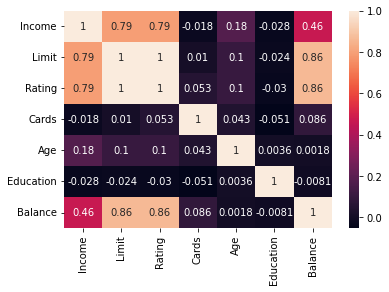
PROBLEM: Which feature is the strongest predictor of Balance in the data?
sns.heatmap(credit.corr(numeric_only = True), annot = True)
<AxesSubplot: >
X = credit[['Rating']]
y = credit['Balance']
PROBLEM: Build a LinearRegression model, determine the Root Mean Squared Error and interpret the slope and intercept.
credit_model = LinearRegression()
credit_model.fit(X, y)
LinearRegression()In a Jupyter environment, please rerun this cell to show the HTML representation or trust the notebook.
On GitHub, the HTML representation is unable to render, please try loading this page with nbviewer.org.
LinearRegression()
print(f'The model is y = {credit_model.coef_[0]}x + {credit_model.intercept_}')
The model is y = 2.5662403273433196x + -390.84634178723786
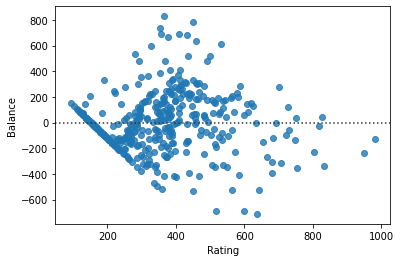
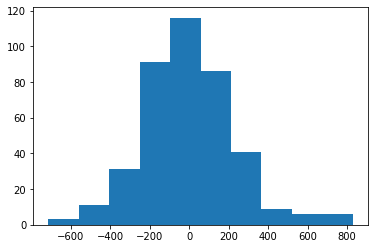
PROBLEM: Examine the residual plot and histogram of residuals. Do they look as they should?
sns.residplot(data = credit, x = X, y = y)
<AxesSubplot: xlabel='Rating', ylabel='Balance'>
plt.hist(y - credit_model.predict(X))
(array([  3.,  11.,  31.,  91., 116.,  86.,  41.,   9.,   6.,   6.]),
 array([-712.2825064 , -558.1506416 , -404.01877679, -249.88691199,
         -95.75504718,   58.37681762,  212.50868243,  366.64054724,
         520.77241204,  674.90427685,  829.03614165]),
 <BarContainer object of 10 artists>)
Other Models#
If your goal is more around statistical inference and you want information about things like hypothesis tests on coefficients, the statsmodels library is a more classical statistics interface that also contains a variety of regression models. Below, the OLS model is instantiated, fit, and the results summarized with the .summary() method.
import statsmodels.api as sm
#instantiate the model
#fit it
#summary
#create the intercept term
#fit again
#summary
Typically, we will use the scikitlearn models on our data. Next class will focus on regression models with more features as well as how we can build higher degree polynomial models for our data.