

Introduction to Decision Trees#
OBJECTIVES
Understand how a decision tree is built for classification and regression
Fit decision tree models using
scikit-learnCompare and evaluate classifiers
import seaborn as sns
import numpy as np
import pandas as pd
import matplotlib.pyplot as plt

from sklearn.model_selection import train_test_split, GridSearchCV
from sklearn.tree import DecisionTreeClassifier, DecisionTreeRegressor, plot_tree
from sklearn.preprocessing import OneHotEncoder
from sklearn.pipeline import Pipeline
from sklearn.compose import make_column_transformer
from sklearn.metrics import ConfusionMatrixDisplay
from sklearn.inspection import DecisionBoundaryDisplay
---------------------------------------------------------------------------
ModuleNotFoundError                       Traceback (most recent call last)
Cell In[1], line 1
----> 1 import seaborn as sns
      2 import numpy as np
      3 import pandas as pd

ModuleNotFoundError: No module named 'seaborn'
Customer Churn#
churn = pd.read_csv('https://raw.githubusercontent.com/jfkoehler/nyu_bootcamp_fa24/refs/heads/main/data/cell_phone_churn.csv')
churn.head()
| state | account_length | area_code | intl_plan | vmail_plan | vmail_message | day_mins | day_calls | day_charge | eve_mins | eve_calls | eve_charge | night_mins | night_calls | night_charge | intl_mins | intl_calls | intl_charge | custserv_calls | churn | |
|---|---|---|---|---|---|---|---|---|---|---|---|---|---|---|---|---|---|---|---|---|
| 0 | KS | 128 | 415 | no | yes | 25 | 265.1 | 110 | 45.07 | 197.4 | 99 | 16.78 | 244.7 | 91 | 11.01 | 10.0 | 3 | 2.70 | 1 | False |
| 1 | OH | 107 | 415 | no | yes | 26 | 161.6 | 123 | 27.47 | 195.5 | 103 | 16.62 | 254.4 | 103 | 11.45 | 13.7 | 3 | 3.70 | 1 | False |
| 2 | NJ | 137 | 415 | no | no | 0 | 243.4 | 114 | 41.38 | 121.2 | 110 | 10.30 | 162.6 | 104 | 7.32 | 12.2 | 5 | 3.29 | 0 | False |
| 3 | OH | 84 | 408 | yes | no | 0 | 299.4 | 71 | 50.90 | 61.9 | 88 | 5.26 | 196.9 | 89 | 8.86 | 6.6 | 7 | 1.78 | 2 | False |
| 4 | OK | 75 | 415 | yes | no | 0 | 166.7 | 113 | 28.34 | 148.3 | 122 | 12.61 | 186.9 | 121 | 8.41 | 10.1 | 3 | 2.73 | 3 | False |
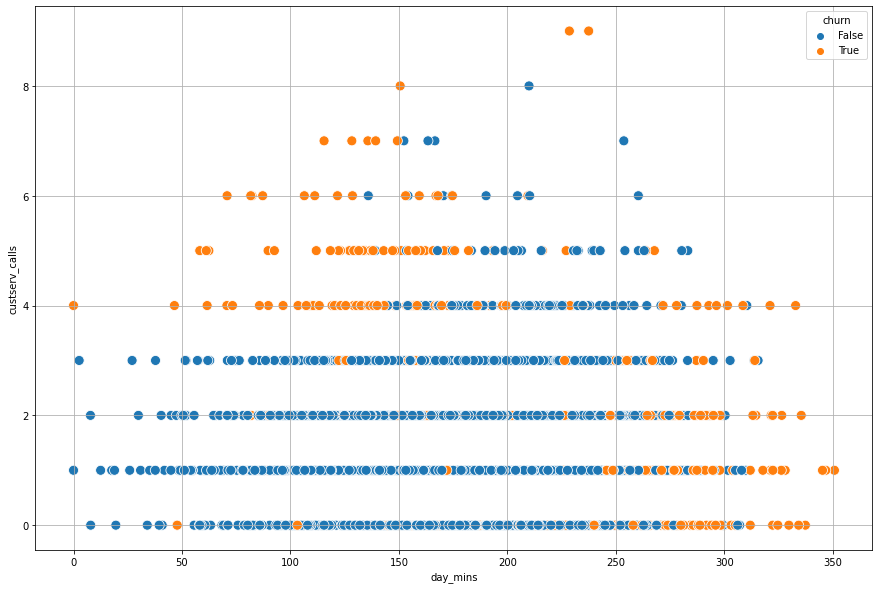
Problem
Can you determine a value to break the data apart that seperates churn from not churn for the
day_mins? What about thecustserv_calls?
plt.figure(figsize = (15, 10))
sns.scatterplot(data = churn, x = 'day_mins', y = 'custserv_calls', hue = 'churn', s = 100)
plt.grid();
tree = DecisionTreeClassifier(max_depth = 2, criterion='entropy')
X = churn[['day_mins', 'custserv_calls']]
y = churn['churn']
tree.fit(X, y)
DecisionTreeClassifier(criterion='entropy', max_depth=2)In a Jupyter environment, please rerun this cell to show the HTML representation or trust the notebook.
On GitHub, the HTML representation is unable to render, please try loading this page with nbviewer.org.
DecisionTreeClassifier(criterion='entropy', max_depth=2)
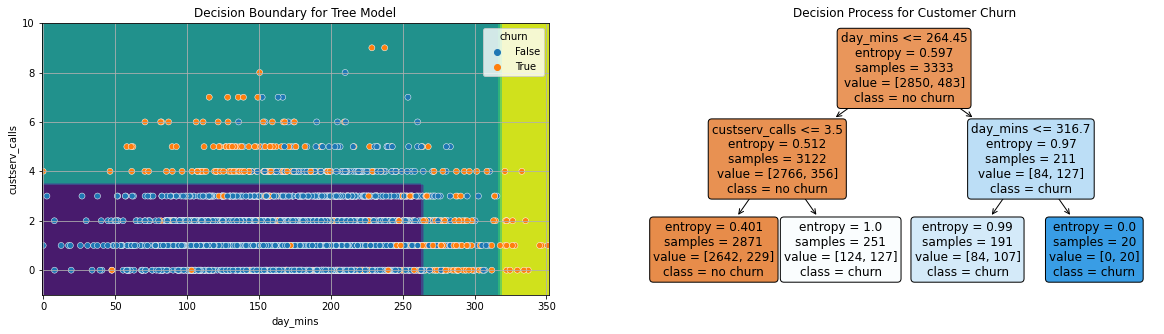
fig, ax = plt.subplots(1, 2, figsize = (20, 5))
DecisionBoundaryDisplay.from_estimator(tree, X, ax = ax[0])
sns.scatterplot(data = X, x = 'day_mins', y = 'custserv_calls', hue = y, ax = ax[0])
ax[0].grid()
ax[0].set_title('Decision Boundary for Tree Model');
plot_tree(tree, feature_names=X.columns,
         filled = True,
         fontsize = 12,
         ax = ax[1],
         rounded = True,
         class_names = ['no churn', 'churn'])
ax[1].set_title('Decision Process for Customer Churn');
Titanic Dataset#
#load the data
titanic = sns.load_dataset('titanic')
titanic.head(5) #shows first five rows of data
| survived | pclass | sex | age | sibsp | parch | fare | embarked | class | who | adult_male | deck | embark_town | alive | alone | |
|---|---|---|---|---|---|---|---|---|---|---|---|---|---|---|---|
| 0 | 0 | 3 | male | 22.0 | 1 | 0 | 7.2500 | S | Third | man | True | NaN | Southampton | no | False |
| 1 | 1 | 1 | female | 38.0 | 1 | 0 | 71.2833 | C | First | woman | False | C | Cherbourg | yes | False |
| 2 | 1 | 3 | female | 26.0 | 0 | 0 | 7.9250 | S | Third | woman | False | NaN | Southampton | yes | True |
| 3 | 1 | 1 | female | 35.0 | 1 | 0 | 53.1000 | S | First | woman | False | C | Southampton | yes | False |
| 4 | 0 | 3 | male | 35.0 | 0 | 0 | 8.0500 | S | Third | man | True | NaN | Southampton | no | True |
#subset the data to binary columns
data = titanic.loc[:4, ['alone', 'adult_male', 'survived']]
data
| alone | adult_male | survived | |
|---|---|---|---|
| 0 | False | True | 0 |
| 1 | False | False | 1 |
| 2 | True | False | 1 |
| 3 | False | False | 1 |
| 4 | True | True | 0 |
Suppose you want to use a single column to predict if a passenger survives or not. Which column will do a better job predicting survival in the sample dataset above?
Entropy#
One way to quantify the quality of the split is to use a quantity called entropy. This is determined by:
With a decision tree the idea is to select a feature that produces less entropy.
#all the same -- probability = 1
1*np.log2(1)
0.0
#half and half -- probability = .5
-(1/2*np.log2(1/2) + 1/2*np.log2(1/2))
1.0
#subset the data to age, pclass, and survived five rows
data = titanic.loc[:4, ['age', 'pclass', 'survived']]
data
| age | pclass | survived | |
|---|---|---|---|
| 0 | 22.0 | 3 | 0 |
| 1 | 38.0 | 1 | 1 |
| 2 | 26.0 | 3 | 1 |
| 3 | 35.0 | 1 | 1 |
| 4 | 35.0 | 3 | 0 |
#compute entropy for pclass
#first class entropy
first_class_entropy = -(2/2*np.log2(2/2))
first_class_entropy
-0.0
#pclass entropy
third_class_entropy = -(1/3*np.log2(1/3) + 2/3*np.log2(2/3))
third_class_entropy
0.9182958340544896
#weighted sum of these
pclass_entropy = 2/5*first_class_entropy + 3/5*third_class_entropy
pclass_entropy
0.5509775004326937
#splitting on age < 30
entropy_left = -(1/2*np.log2(1/2) + 1/2*np.log2(1/2))
entropy_right = -(1/3*np.log2(1/3) + 2/3*np.log2(2/3))
entropy_age = 2/5*entropy_left + 3/5*entropy_right
entropy_age
0.9509775004326937
#original entropy
original_entropy = -((3/5)*np.log2(3/5) + (2/5)*np.log2(2/5))
original_entropy
0.9709505944546686
# improvement based on pclass
original_entropy - pclass_entropy
0.4199730940219749
#improvement based on age < 30
original_entropy - entropy_age
0.01997309402197489
Using sklearn#
The DecisionTreeClassifier can use entropy to build a full decision tree model.
X = data[['age', 'pclass']]
y = data['survived']
from sklearn.tree import DecisionTreeClassifier
#DecisionTreeClassifier?
#instantiate
tree2 = DecisionTreeClassifier(criterion='entropy', max_depth = 1)
#fit
tree2.fit(X, y)
DecisionTreeClassifier(criterion='entropy', max_depth=1)In a Jupyter environment, please rerun this cell to show the HTML representation or trust the notebook.
On GitHub, the HTML representation is unable to render, please try loading this page with nbviewer.org.
DecisionTreeClassifier(criterion='entropy', max_depth=1)
#score it
tree2.score(X, y)
0.8
#predictions
tree2.predict(X)
array([0, 1, 0, 1, 0])
Visualizing the results#
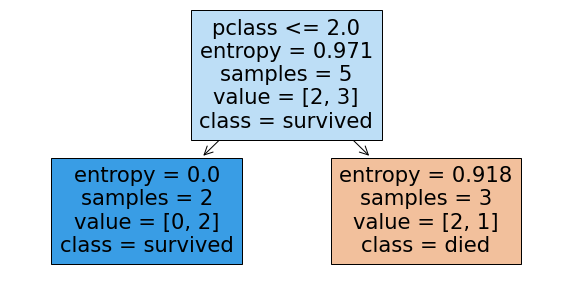
The plot_tree function will plot the decision tree model after fitting. There are many options you can use to control the resulting tree drawn.
from sklearn.tree import plot_tree
#plot_tree
fig, ax = plt.subplots(figsize = (10, 5))
plot_tree(tree2,
          feature_names=X.columns,
          class_names=['died', 'survived'], filled = True);
PROBLEM
Build a Logistic Regression pipeline to predict purchase.
purchase_data = pd.read_csv('https://raw.githubusercontent.com/YBI-Foundation/Dataset/refs/heads/main/Customer%20Purchase.csv')
purchase_data.head()
| Customer ID | Age | Gender | Education | Review | Purchased | |
|---|---|---|---|---|---|---|
| 0 | 1021 | 30 | Female | School | Average | No |
| 1 | 1022 | 68 | Female | UG | Poor | No |
| 2 | 1023 | 70 | Female | PG | Good | No |
| 3 | 1024 | 72 | Female | PG | Good | No |
| 4 | 1025 | 16 | Female | UG | Average | No |
from sklearn.linear_model import LogisticRegression
from sklearn.preprocessing import StandardScaler
encoder = make_column_transformer((OneHotEncoder(), ['Gender', 'Education', 'Review']),
                                 remainder = 'passthrough',
                                 verbose_feature_names_out=False)
model = ''
lgr_pipe = Pipeline([('transform', encoder), ('model', LogisticRegression())])
X = purchase_data.iloc[:, 1:-1]
y = purchase_data['Purchased']
lgr_pipe.fit(X, y)
Pipeline(steps=[('transform',
                 ColumnTransformer(remainder='passthrough',
                                   transformers=[('onehotencoder',
                                                  OneHotEncoder(),
                                                  ['Gender', 'Education',
                                                   'Review'])],
                                   verbose_feature_names_out=False)),
                ('model', LogisticRegression())])
In a Jupyter environment, please rerun this cell to show the HTML representation or trust the notebook. On GitHub, the HTML representation is unable to render, please try loading this page with nbviewer.org.
Pipeline(steps=[('transform',
                 ColumnTransformer(remainder='passthrough',
                                   transformers=[('onehotencoder',
                                                  OneHotEncoder(),
                                                  ['Gender', 'Education',
                                                   'Review'])],
                                   verbose_feature_names_out=False)),
('model', LogisticRegression())])ColumnTransformer(remainder='passthrough',
transformers=[('onehotencoder', OneHotEncoder(),
['Gender', 'Education', 'Review'])],
verbose_feature_names_out=False)['Gender', 'Education', 'Review']
OneHotEncoder()
['Age']
passthrough
LogisticRegression()
lgr_pipe.score(X, y)
0.56
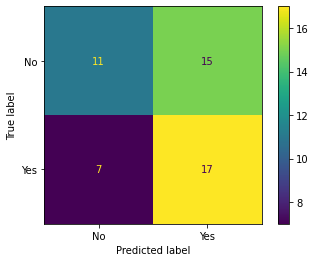
ConfusionMatrixDisplay.from_estimator(lgr_pipe, X, y)
<sklearn.metrics._plot.confusion_matrix.ConfusionMatrixDisplay at 0x7f8f19a97790>
Problem
Build a DecisionTreeClassifier pipeline to predict purchase.
tree_pipe = Pipeline([('transform', encoder), ('model', DecisionTreeClassifier(max_depth = 4))])
tree_pipe.fit(X, y)
Pipeline(steps=[('transform',
ColumnTransformer(remainder='passthrough',
                  transformers=[('onehotencoder', OneHotEncoder(),
                                 ['Gender', 'Education', 'Review'])],
verbose_feature_names_out=False)),
('model', DecisionTreeClassifier(max_depth=4))])In a Jupyter environment, please rerun this cell to show the HTML representation or trust the notebook. On GitHub, the HTML representation is unable to render, please try loading this page with nbviewer.org.
Pipeline(steps=[('transform',
                 ColumnTransformer(remainder='passthrough',
                                   transformers=[('onehotencoder',
                                                  OneHotEncoder(),
                                                  ['Gender', 'Education',
                                                   'Review'])],
                                   verbose_feature_names_out=False)),
('model', DecisionTreeClassifier(max_depth=4))])ColumnTransformer(remainder='passthrough',
transformers=[('onehotencoder', OneHotEncoder(),
['Gender', 'Education', 'Review'])],
verbose_feature_names_out=False)['Gender', 'Education', 'Review']
OneHotEncoder()
['Age']
passthrough
DecisionTreeClassifier(max_depth=4)
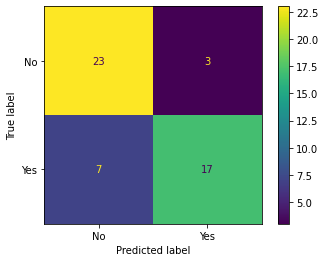
ConfusionMatrixDisplay.from_estimator(tree_pipe, X, y)
<sklearn.metrics._plot.confusion_matrix.ConfusionMatrixDisplay at 0x7f8f1ba593d0>
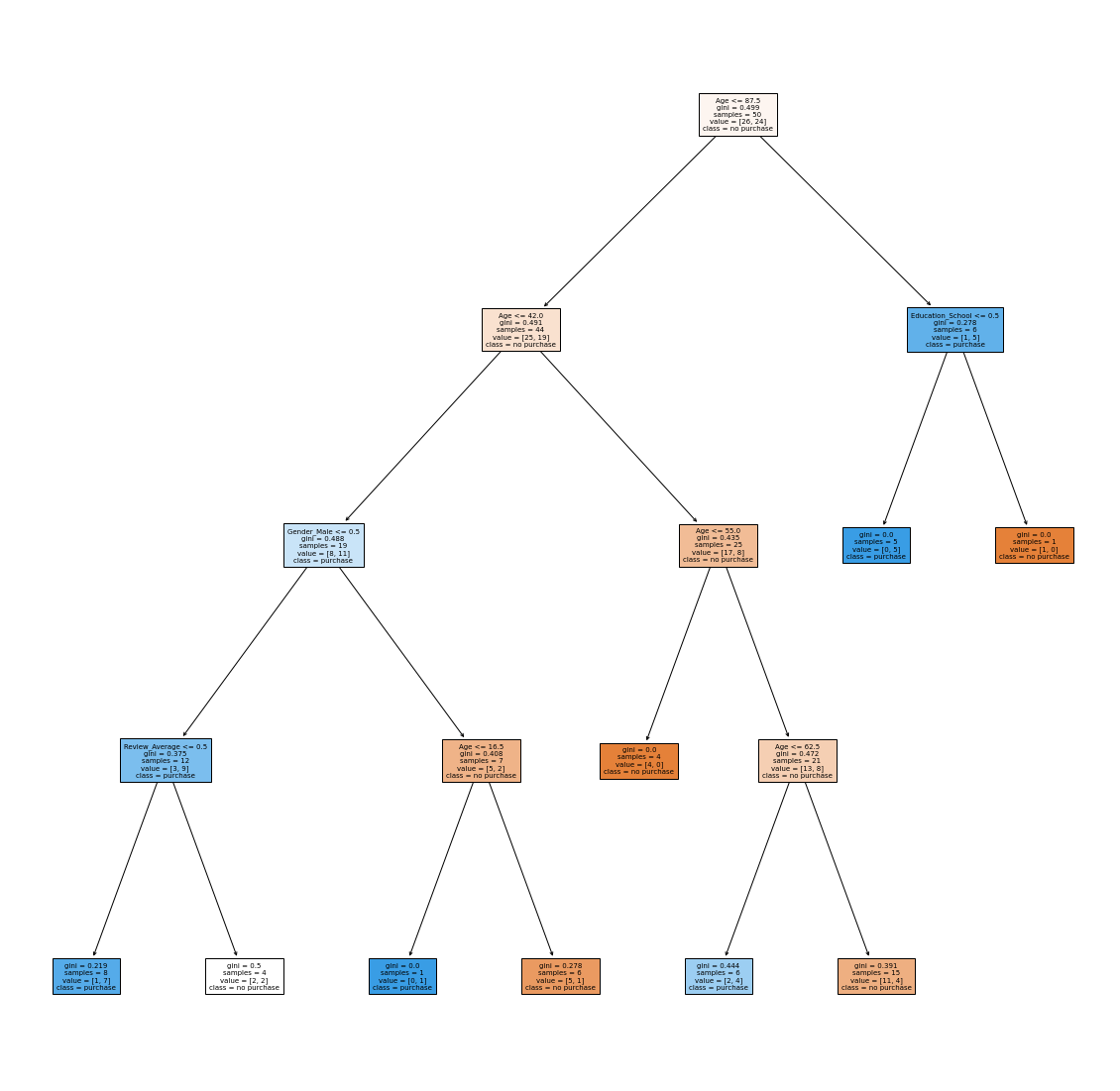
plt.figure(figsize = (20, 20))
plot_tree(tree_pipe['model'], feature_names=tree_pipe['transform'].get_feature_names_out(),
         class_names = ['no purchase', 'purchase'],
         filled = True,
         fontsize=7);
Extra Problem
Suppose you are only able to target 50% of your customers with an advertising incentive. If you only target the highest probability of purchases, which of the models provides the biggest “lift” over the baseline? (Percent of positive purchases) Lift values and argument in slack.
#predict proba for positive class
#sort by probability
#percent of positives on first 50%?
Problem
For next class, read the chapter “Decision Analytic Thinking: What’s a Good Model?” from Data Science for Business. Pay special attention to the cost benefit analysis. You will be asked to use cost/benefit analysis to determine the “best” classifier for an example dataset next class.
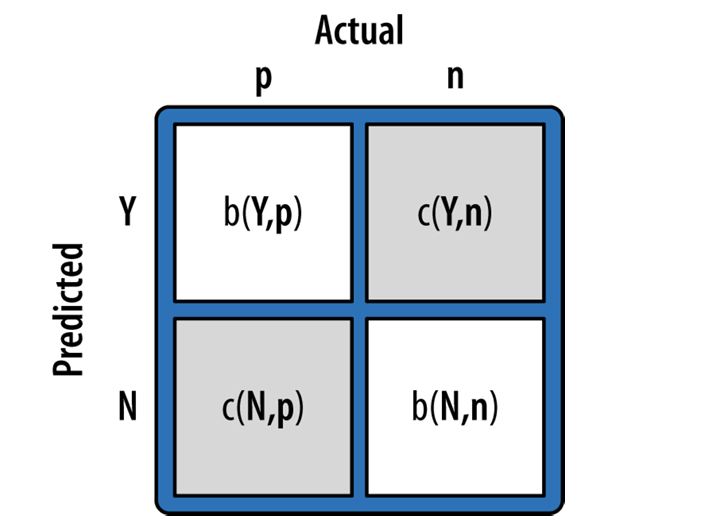
#example cost benefit matrix
cost_benefits = np.array([ [0, -1], [0, 99]])
cost_benefits
array([[ 0, -1],
       [ 0, 99]])
The expected value is computed by:
use this to calculate the expected profit of the Decision Tree and Logistic Regression model. Which is better? Expected Value and argument in slack.
from sklearn.metrics import confusion_matrix
mat = confusion_matrix(y, tree_pipe.predict(X))
mat
array([[23,  3],
       [ 7, 17]])
mat.sum()
50
#expected profit for decision tree model
(((mat/mat.sum())*cost_benefits)).sum()
33.6
lgr_mat = confusion_matrix(y, lgr_pipe.predict(X))
lgr_mat/lgr_mat.sum()
array([[0.22, 0.3 ],
       [0.14, 0.34]])
#expected profit for logistic model
((lgr_mat/lgr_mat.sum())*cost_benefits).sum()
33.36000000000001